



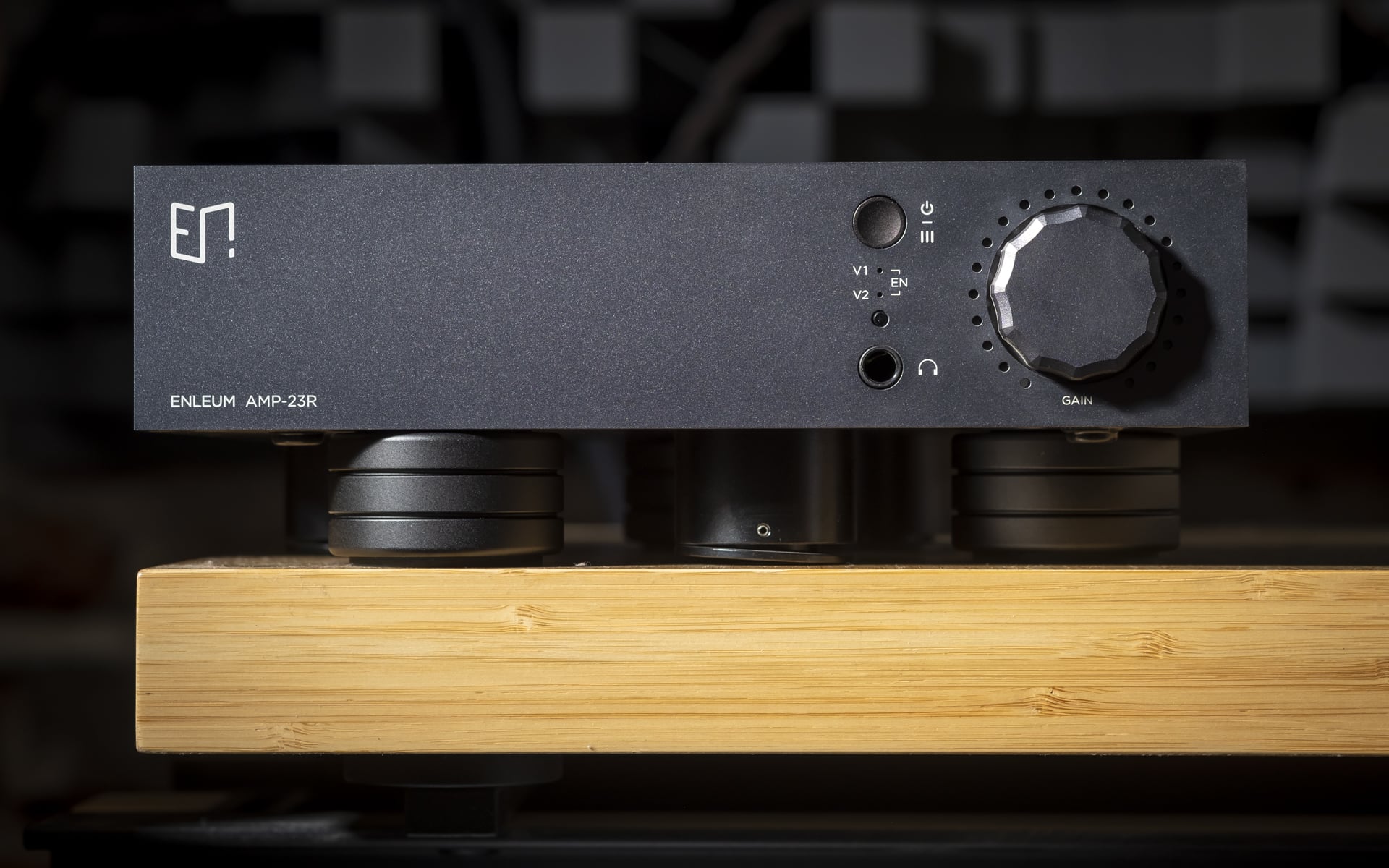
Rigidity Solves One Problem. Compliance Solves Another.
We’ve written elsewhere about why a loudspeaker cabinet needs to stay rigid: the short version is that a driver pushes against its cabinet to move air, so the cabinet has to hold its position for that motion to translate cleanly into sound. Electronics don’t have that constraint.
A DAC, streamer, preamp or amplifier has no driver and nothing pushing against its chassis, so there’s no fixed reference to protect. Turntables are a case apart again: no driver either, but a cartridge whose entire job is converting mechanical movement into electrical signal, which makes it the most vibration-sensitive component in any system. That single set of differences changes the isolation problem for each, and it’s why the AUVA EQ is built the way it is.
What Compliance Actually Means Here
“Compliance” means introducing a precisely tuned spring rate beneath the component, and doing that changes more than local stiffness; it changes the entire dynamic system. Once a component is sitting on a compliant element rather than a rigid one, the assembly behaves as a mass on a spring, and its behaviour is now governed by the isolator’s stiffness and the component’s mass, not by how rigid or well-braced the component’s own chassis happens to be. In that new system, vibration is drawn into the isolator rather than the equipment: the isolator does the moving, while the mass sitting on it stays comparatively still. The isolator is tuned so its own natural frequency sits well below anything relevant to the equipment above it, so movement in the isolator itself isn’t a concern, and the equipment ends up seeing far less vibration across the frequencies that actually matter to it.
The engineering challenge isn’t deciding whether to use compliance; it’s tuning that spring rate correctly for the mass resting on it. Get it wrong (too soft, or unmatched to the load) and the system doesn’t isolate cleanly; it just adds uncontrolled movement.
Microphony: The Reason This Matters
Microphony is the process by which mechanical vibration is converted into unwanted electrical signal inside a component. It shows up wherever a physical structure inside the equipment is free to move under vibration and affect the signal as a result: a transformer core shifting fractionally against its windings, a capacitor’s plates moving relative to one another, or, most audibly, a valve’s internal electrode structure flexing and modulating the signal passing straight through it. The mechanism is identical in each case; only the physical detail changes. Valve gear makes the effect easiest to hear, which is why it gets mentioned most often, but the same physics is present in solid-state electronics too, just at a lower level.
Vibration reaches a component from two structural directions: transmitted up from whatever it’s resting on, and generated internally by its own transformers and moving parts. There’s a third path too: airborne sound itself striking the casework, which isolation addresses to a lesser degree, and which matters most for turntables specifically. Controlling the two structural paths is a job rigidity can’t do, because rigidity only addresses a component that has nothing to protect from movement in the first place.
Turntables: The Most Direct Case
Every component susceptible to microphony has some vibration-to-signal pathway buried inside it. A turntable doesn’t bury it; the pathway is the whole point of the design. A cartridge’s job is to convert mechanical movement into an electrical signal, which means it can’t distinguish between the movement it’s supposed to be reading from the groove and any unwanted movement reaching the plinth from the shelf beneath it. Unwanted vibration doesn’t cause microphony in a turntable so much as it becomes signal, indistinguishably mixed in with the music.
A turntable’s vibration problem actually comes from three separate places, and only one of them is something a listener can still do anything about once the deck is out of the factory. Vibration generated internally, by the motor and bearing, is settled at the design stage, and there’s no user-facing fix for it afterwards. Airborne sound striking the plinth and arm, acoustic feedback, can be reduced at the design stage too, with lids or shielding, though it’s rarely eliminated given how much a listening room’s own acoustic behaviour varies. Vibration transmitted up from the shelf or floor is different: it’s the one source still addressable after the fact, and it’s exactly what isolation beneath the deck controls.
In practical terms, that makes isolation the only lever a listener actually has to influence a turntable’s vibration behaviour once it’s already on the shelf, which is what makes targeted isolation more important here than almost anywhere else in a system. Whether a deck is rigid-plinth or has its own internal suspension, the EQ is doing the same job at the base level: controlling the vibration reaching the deck from the shelf or rack beneath it, before it ever gets near the platter, arm or cartridge. Customers running suspended designs, including the Linn Sondek LP12, use the AUVA EQ successfully for exactly this reason: it’s addressing a different vibration path from the one the deck’s own suspension is managing internally.
Where Rigid Mounts And Isolation Pads Fall Short
Two conventional approaches try to solve this, and each fails for a specific reason.
A rigid mount or spike gives vibration a continuous, low-impedance path straight into the chassis; a solid connection doesn’t isolate anything; it just transmits. A compression-based pad, such as rubber or Sorbothane, works by adding damping rather than by forming a properly tuned spring-mass system: it reduces some vibration passing through it, but without a defined spring rate matched to the load, there’s no specific frequency range where it’s reliably isolating rather than simply damping, and it can deform under sustained load, undermining stability over time.
One extreme transmits vibration essentially unchanged. The other reduces it somewhat through damping, without ever forming the kind of tuned system that isolates a specific frequency range the way controlled compliance does.
How The AUVA EQ Applies It
The EQ uses two stages, each handling a different part of the problem.
The rigid outer shell sits in direct contact with the component and deals with vibration generated at the source, inside the equipment itself. As vibration enters the shell, the packed particles inside shift and collide, converting kinetic energy into heat. That doesn’t shift the frequency at which the chassis resonates (resonance is a property of frequency, not amplitude), but it does reduce the amplitude of the vibration reaching it, even in a chassis that wasn’t particularly well braced to begin with. The same mechanism helps with airborne acoustic feedback for the same reason.
Beneath the shell sits the CSA, a compliant, precision-tuned air-spring element. The same principle described earlier applies here: once the component is sitting on the CSA, the CSA and the component form a single tuned system, with the CSA’s stiffness and the component’s mass governing the dynamics rather than the component’s own rigidity. Vibration arriving from below is drawn into that system at the isolator, which is tuned well clear of any frequency that matters to the equipment, rather than reaching the chassis at the frequencies that matter. Less vibration reaching the chassis at those frequencies means less opportunity for microphony in whatever’s sitting inside it.
What The Measurements Show
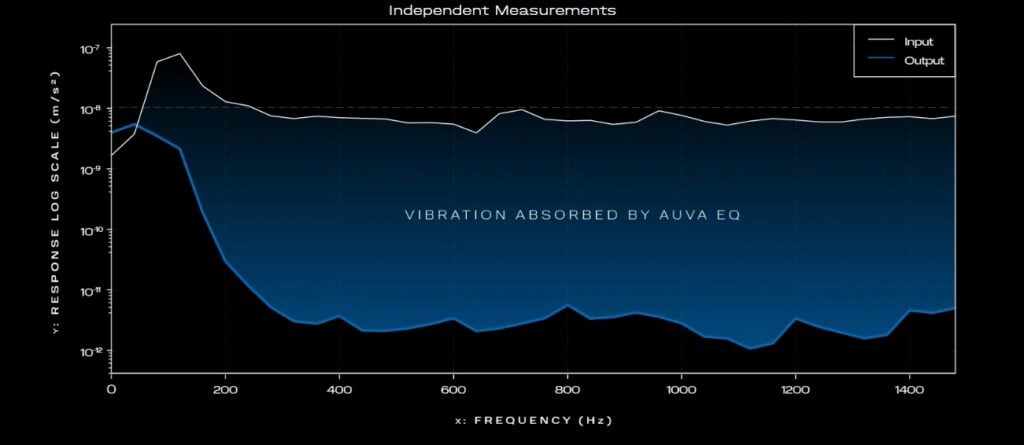
Independent testing recorded vibration input against vibration output through the AUVA EQ across a swept range of roughly 20Hz to 1500Hz. Below around 100Hz, the reduction is modest: low-frequency energy carries more amplitude to work through, and the compliant stage’s isolation efficiency naturally rolls off toward the bottom of the range. From roughly 200Hz upward, though, the EQ reduces through-transmitted vibration by two to three orders of magnitude, holding that reduction consistently to the top of the tested range, a broad, sustained result across exactly the frequency range where mechanical vibration is most likely to provoke microphony.
Valve Equipment: An Amplified Case

Valve gear deserves its own mention because the same microphony mechanism affects it more visibly than almost any other type of component. Inside a valve, the electrode structure (grid, cathode and anode) is a physically delicate assembly suspended within the glass envelope, and vibration reaching that structure changes the spacing between elements fractionally as it moves. Because the valve is amplifying whatever passes through it, any signal that mechanical movement introduces gets amplified along with the music, which is why the effect is often audible as a faint ringing or “pinging” when a valve is tapped directly. The valve doesn’t distinguish between wanted and unwanted signal any more than a cartridge does; it just amplifies what reaches it.
That sensitivity comes from two directions at once, echoing the same two-source pattern used throughout this article: vibration transmitted up from the rack or shelf, and vibration generated internally by the component’s own transformer and heater supply. Controlling both is exactly the job the AUVA EQ’s two-stage construction is designed for, which is why valve equipment tends to show some of the clearest, most repeatable improvements from equipment isolation of any component type.
Fitting
Use the same number of EQs as the component has stock feet, positioned where those feet sit, or as close to that position as the chassis allows, to keep the manufacturer’s intended weight distribution intact. The compliant CSA inserts are supplied in three weight ratings so the spring rate is matched to the load actually resting on it, and each EQ is height-adjustable by up to 3mm for levelling. For turntables, this means positioning the EQs beneath the deck’s own base, sized to the deck’s weight and foot count, whether or not the deck has its own internal suspension.
The Same Principle, A Different Problem: AUVA SW
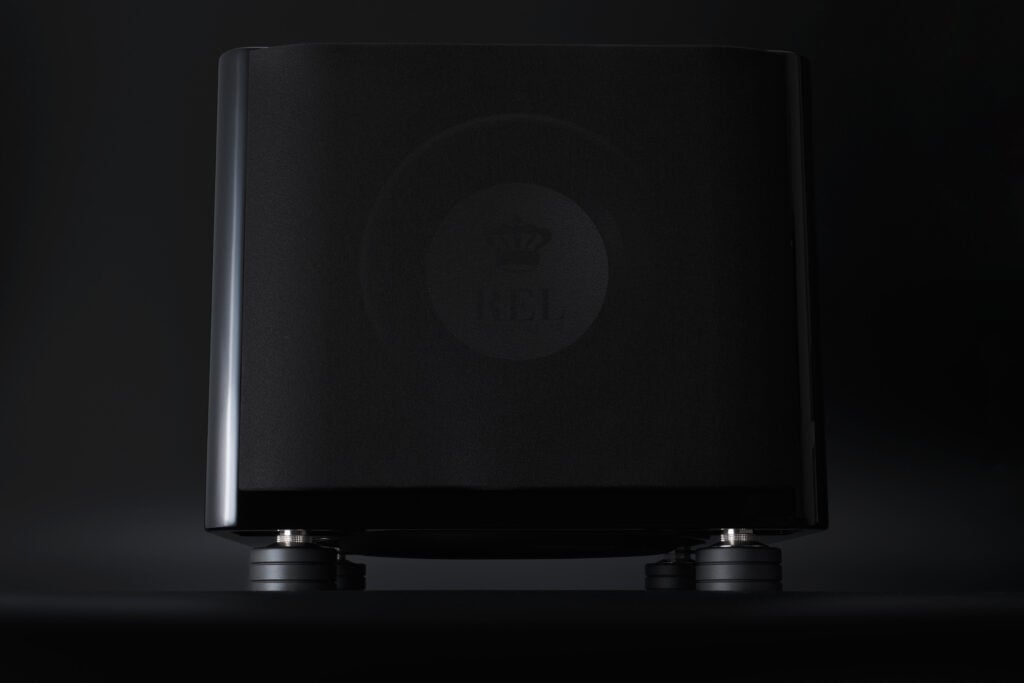
Controlled compliance isn’t unique to equipment isolation: it’s the same governing idea behind the AUVA SW, applied to a different energy problem entirely. A subwoofer produces mostly omnidirectional, long-wavelength energy that transmits readily through floors, and, unlike a stand-mount or floorstanding speaker, that energy is better decoupled than locked rigid.
The AUVA SW handles it through a three-stage construction: an AUVA particle pod at the top absorbing and dissipating vibration the same way the EQ’s shell does, a CSA-SW silicone element beneath it tuned specifically for subwoofer-level energy, and a precision-machined aluminium housing that constrains how that compliance moves so the isolator stays composed under a heavy, high-amplitude load. The CSA-SW comes in six weight classes so the spring rate is matched to the subwoofer sitting on it, following the same logic as the EQ’s three weight ratings, just scaled for far greater force.
Different energy, different tuning, same underlying principle: control the vibration rather than fight it outright.
The Bottom Line
Speakers get rigidity because their drivers depend on a fixed reference to work against. Electronics get controlled compliance because their vulnerability is vibration reaching sensitive circuitry. Subwoofers sit in their own category again, needing compliance tuned to far higher energy. Same particle-damping core throughout the AUVA range, three different mechanical answers, because it’s three different problems.
We can’t tell you how any of this will sound in your system; nobody honestly can. But customers most often tell us they hear more focus and clarity, with their components’ own character left alone. And if you’d rather test that against your own ears than take our word for it, that’s what the 60 days are for. You’ll hear a difference, or your money back.


 EN
EN  DE
DE  NL
NL  FR
FR  JA
JA  PT
PT  ES
ES  SV
SV  IT
IT  FI
FI