



Why Loudspeakers Vibrate (And Why It Matters More Than You Think)
When a loudspeaker plays music, it is not only pushing air to create sound; it is also generating reactive forces within its own structure. According to Newton’s Third Law, every action has an equal and opposite reaction. As the drive units move forward and backwards, opposing forces are transferred into the loudspeaker cabinet itself. That energy does not simply disappear; it travels into the cabinet, the supporting surface, and the surrounding structure, where it can excite resonances and introduce unwanted colouration and distortion.
Loudspeaker designers work extensively to reduce these unwanted resonances within the cabinet itself, using approaches such as internal bracing, constrained-layer damping, composite materials, and increased mass or stiffness. Some of these methods are highly effective, though often complex and expensive to implement. Even so, no loudspeaker exists in complete mechanical isolation from its environment.
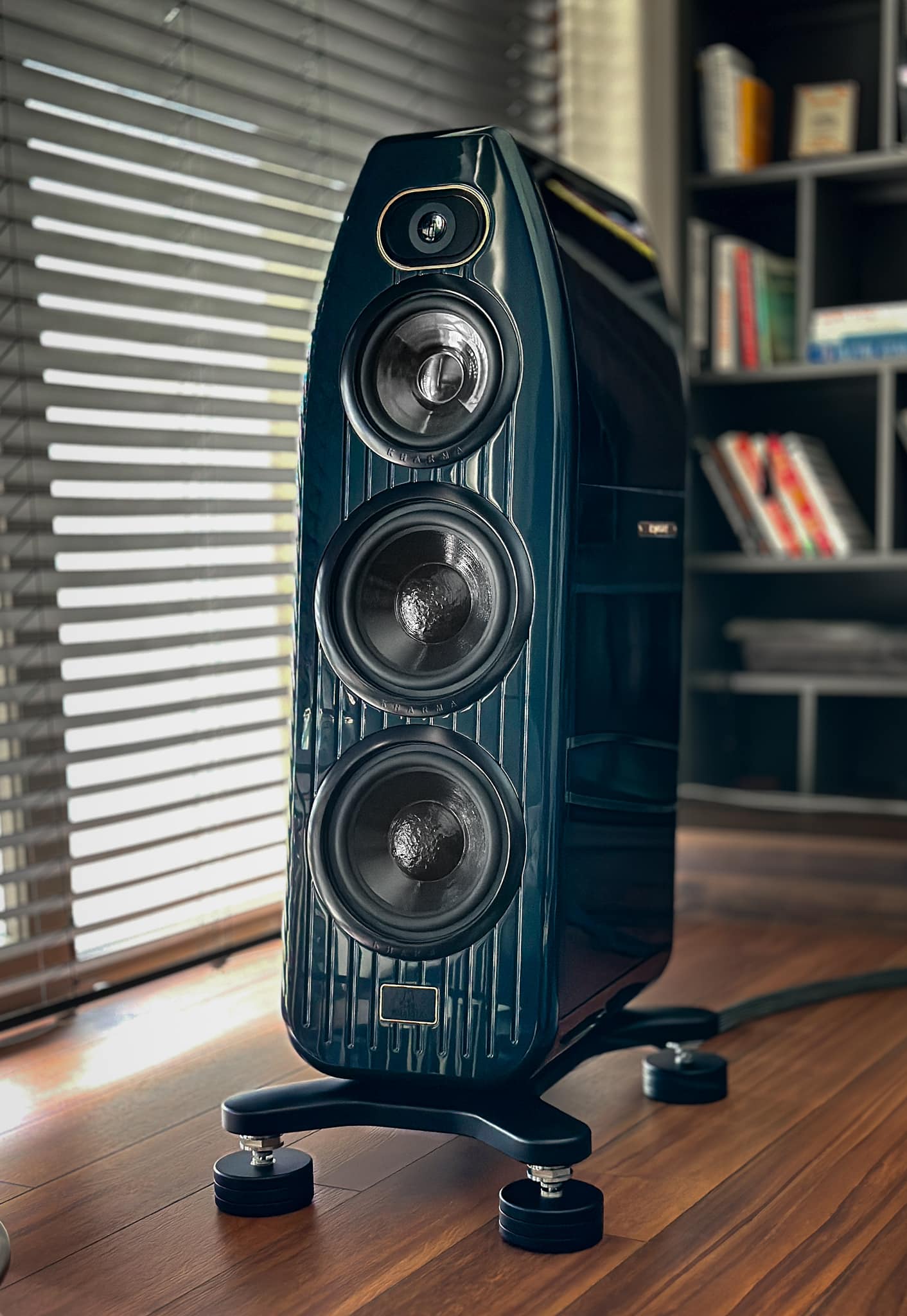
A loudspeaker interacts mechanically with whatever it is placed upon, whether that is a stand, carpet, suspended floor, or concrete slab. Each supporting surface has its own stiffness, mass, and resonant behaviour. When vibrational energy is transferred into it, that surface effectively becomes part of the playback system, storing and re-radiating energy back into the environment at delayed intervals. These delayed resonances can blur timing, smear low-level detail, and reduce perceived clarity. In this sense, the performance of a loudspeaker is partially defined not only by its own design, but also by the mechanical behaviour of the structure supporting it.
What Is Compliant Speaker Isolation, And When Does It Actually Work?
Speaker isolation pads, foam supports, and spring-based isolators are among the most common solutions people reach for, and in the right situation they can work well. For electronic components, the primary goal is often to prevent external vibration travelling up from the supporting surface into the equipment itself, making compliant isolation an effective solution. Similarly, for subwoofers, where the objective is to reduce the transmission of low-frequency energy into the floor and surrounding structure, compliant isolators can also work extremely well. This is why we use compliance in both our AUVA EQ and AUVA SW isolators, albeit to address different mechanical problems.
The catch is that these materials only work as intended when matched correctly to the weight of whatever is sitting on them. Too light or too heavy, and the pad stops absorbing vibration effectively, and can even start making things worse by adding a resonance of its own. Think of it like a car’s suspension: set up for the right load, it smooths out the bumps. Set up for the wrong load, it bounces and wallows, creating instability rather than curing it.
The fundamental problem is that compliance works by allowing movement. For subwoofers and electronic equipment, that trade-off is acceptable, and often desirable. But loudspeakers have a very different set of requirements, which is where compliant isolation begins to reveal its limitations.
How Some Speaker Isolation Pads Undermine Speaker Timing and Clarity
One of the less obvious effects of compliant isolation systems is time-domain energy storage. Not all compliant materials behave the same way in this respect, and the distinction largely lies between elastic behaviour and viscous damping. An ideal elastic material does not dissipate energy; instead, it stores mechanical energy under load and releases it again when that load is removed, much like a spring. In contrast, materials with stronger viscous characteristics are better at converting mechanical energy into heat, reducing the amount of energy that is returned back into the system.
In practice, most affordable compliant isolators sit somewhere between these two extremes. They provide a degree of isolation, but also partially store mechanical energy before releasing it back into the system with a time lag. This delayed energy release can contribute to smearing, reduced transient precision, and a subtle loss of clarity, particularly in systems where low-level detail retrieval is critical.
A useful way to think about it is the difference between landing on a trampoline and landing on sand. The trampoline stores your energy and throws it back at you, while sand simply absorbs and dissipates it. This storage and release can introduce very low-level temporal smearing, where transient information is not lost, but subtly redistributed over time, affecting perceived attack, timing precision, and overall definition.
How Cabinet Movement Impacts Stereo Imaging and Detail
Our ears are remarkably sensitive to these timing and spatial cues, particularly in how they interpret the leading edges of transients and the stability of the spatial positioning detail within a soundstage. When these relationships are subtly disrupted, the perception is not one of obvious distortion, but rather a reduction in clarity, manifesting as slightly blurred transients, softened detail retrieval, and a less precisely defined stereo image.
Why Speaker Engineers Always Design for a Rock-Solid Cabinet Reference
Many listeners notice an immediate sense of a smoother, less edgy sound with compliant isolation, thanks to reduced floor vibrations, and that is a genuine benefit. But the trade-off is often reduced clarity and precision, because the cabinet no longer acts as the rock-solid reference the drivers need.
Loudspeakers are typically designed, measured, and critically voiced by their engineers on solid, stable platforms, not compliant ones. This matters more than it might initially appear. The crossover network, the internal circuitry that divides the audio signal between the tweeter, midrange, and woofer, is engineered at the point of manufacture to account for the precise physical position and distance of each driver relative to the listening position. The time alignment between those drivers, and the phase relationships that determine how coherently the sound integrates, are all optimised assuming a fixed, stable cabinet. When that cabinet is free to rock, even subtly, the acoustic centre of each driver shifts dynamically with the music. No crossover can account for that movement after the fact, meaning the careful engineering built into the speaker is being partially undermined by the very thing intended to improve it.
From Compliance to Spikes: Why Neither Is True Speaker Isolation
At the opposite extreme, rigid coupling methods such as spikes are often assumed to eliminate vibration entirely. In practice, they do not remove energy, but instead provide a highly efficient mechanical path into the supporting structure. While this can improve stability and reduce cabinet movement, it also means the behaviour of the loudspeaker becomes increasingly dependent on the properties of the floor beneath it.
On carpeted floors, spikes are often beneficial because they penetrate through the soft surface layer and create a firmer, more stable connection to the sub-floor beneath. However, the underlying principle remains the same: vibrational energy is still being transferred into the supporting structure. If the floor itself is prone to resonance, that energy can still be stored and re-radiated back into the system. On hard floors such as wood, tile, or stone, these interactions can become even more apparent, as there is less intermediate material between the loudspeaker and the structure itself.
Energy is transferred efficiently into a surface that is often reflective and resonant in its own right, capable of re-radiating that energy back into the room. The practical consequence is that spiked speakers on a suspended timber floor will sound meaningfully different to the same speakers on a concrete slab, not because the speakers have changed, but because the floor has effectively become part of the loudspeaker system. This floor-type dependency is a significant and often overlooked limitation of spike coupling: it makes the performance of a carefully engineered loudspeaker contingent on an architectural variable entirely outside the manufacturer’s control.
How AUVA Solves Both Problems: Rigid Stability With Particle Impact Damping
That’s why we developed the AUVA Speaker Isolator range. Rather than relying on springs, soft materials or controlled cabinet movement, AUVA isolators are designed to maintain a stable mechanical reference while dissipating unwanted vibrational energy at the source. The goal is simple: allow loudspeakers to perform with greater clarity, precision and consistency.
At the core of the design is our patent-pending AUVA PID (Particle Impact Damping) technology. Inside each isolator, engineered particles interact within a constrained structure, converting vibration into controlled micro-collisions and frictional losses. Instead of storing energy elastically or reflecting it back into the cabinet, vibrational energy is dissipated as heat across a broad frequency range.
The result is a presentation that sounds more stable, focused and natural. Bass notes start and stop more cleanly, stereo imaging becomes more precise, and low-level detail is easier to resolve. Because the energy is managed internally rather than relying on floor interaction, performance remains consistent across a wide variety of rooms and supporting surfaces.

 EN
EN  DE
DE  NL
NL  FR
FR  JA
JA  PT
PT  ES
ES  SV
SV  IT
IT  FI
FI